Yumi's Blog / Why I Graduated College in 2 Years
Why I Graduated College in 2 Years
I finished my B.S. in Cybersecurity Analytics & Operations at Penn State in two years. Not two and a half. Two.
Here’s how.
Why it mattered
Time is money. And your early 20s are some of the most important years you have.
I started college at age 19. I could have spent those years sitting in classes I didn’t need, going to parties, playing video games. That wasn’t how I wanted to spend that time. Not because of some external pressure. Just because I looked at how I was spending my days and decided I could do better.
So I graduated early. That was the reason. Nothing more complicated than that.
The foundation I didn’t know I had
I went to Yokohama International School in Japan and did the IB Diploma Programme. IB gives you college credits if you score well enough on your exams. I did. That knocked out about a year of gen eds before I ever set foot on campus.
I didn’t know this was possible until I was already partway through IB. My mother chose a school that offered the programme, and I’m genuinely grateful for that. She made the decision long before I understood what it meant. By the time I figured out I could transfer credits to an American university, I was already halfway through the diploma. If she’d sent me somewhere else, this whole path probably doesn’t exist.
I arrived at Penn State already a year ahead, but I wasn’t thinking about graduating early. My original plan was to double major in math and cybersecurity and do it the normal way.
The turning point came at dinner with my family, after my first year. My brother, two years younger than me, was starting to think about college, so I had to explain how the American credit system worked to my Japanese family. Going through it out loud, I added up where I was: 60 credits. That’s almost half of what you need to graduate. I got genuinely excited at that dinner. If I kept pushing, I could actually be done in two years.
College wasn’t the best time, honestly. I was away from my family, away from my friends, in a country that wasn’t home. The faster I could get out and get to work, the better.
Once I saw it was possible, I dropped the math major. Not because I lost interest in math. I was just more focused on cybersecurity at the time, and the double major would have made two years impossible. I made the call and didn’t look back.
How I did it
Test out of what you already know. I’d been building things since high school. Co-founded a math club, worked at Cyberbuzz in Tokyo doing research, was already comfortable with programming. Penn State let me take a placement exam before the semester started for intro programming courses. Passed, got the credits, never attended the class. That’s the fastest credit you’ll ever earn.
Finish the rest online while doing something real. IB covered most of my gen eds, but not all of them. The ones it didn’t cover, I took online while interning at Rutilea, the AI startup in Kyoto that would later hire me full-time. I wasn’t sitting on a campus taking gen eds. I was working and knocking out requirements on the side. When I told them I was graduating, they asked me to join. The internship was how I got in the door.
Take more credits than feels comfortable. Most students take 15. I took more every semester. One semester I took 24, which is the maximum Penn State allows for a bachelor’s student. During summers I took more credits than a typical student graduating in four years would. There was no break where I wasn’t taking classes.
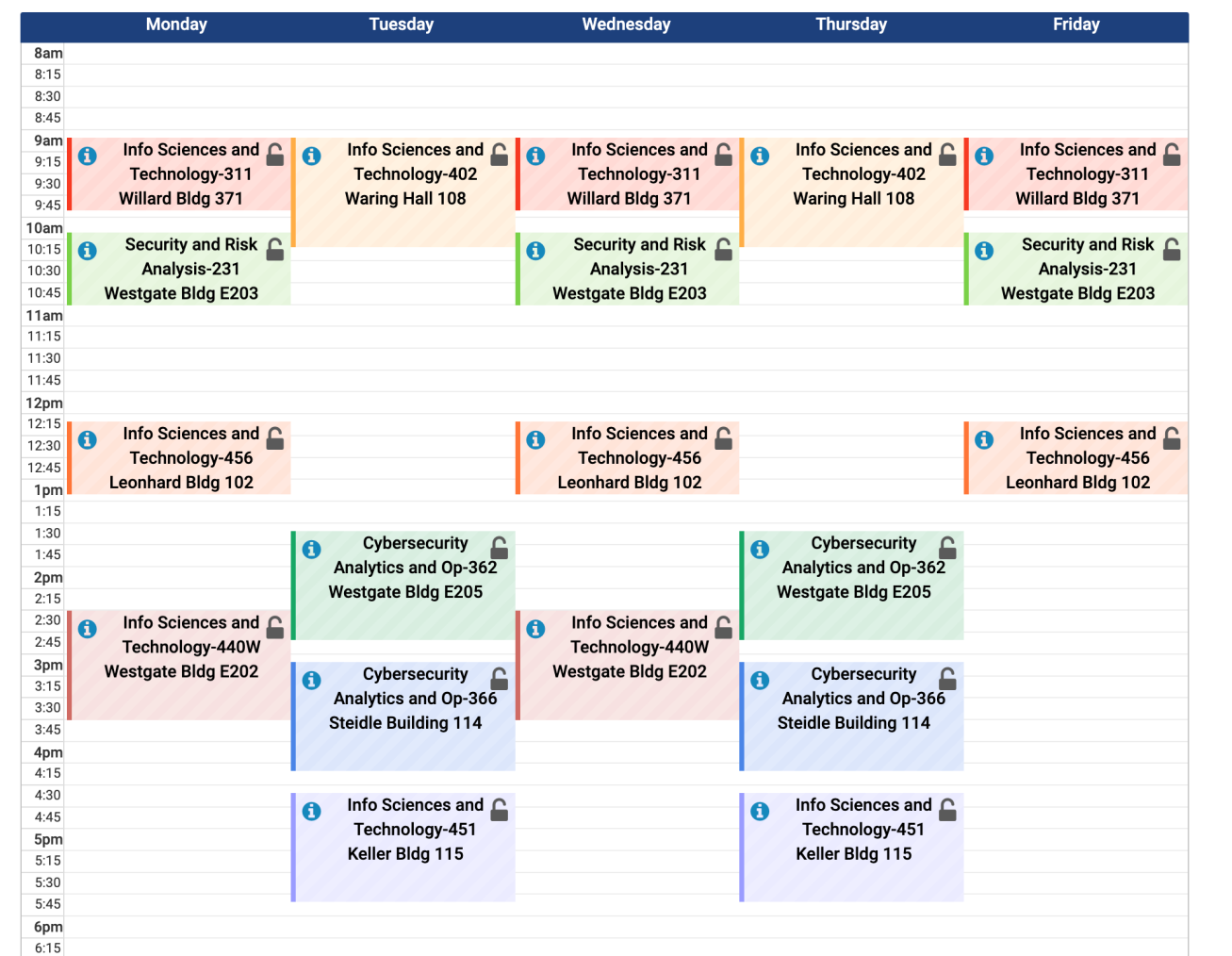
Know which courses actually matter. Some you need to deeply understand. Others you just need to pass. I spent my energy accordingly. Core cybersecurity and development courses got everything. Electives got what they needed.
The routine
Most days followed a similar pattern. I’d wake up naturally in the early morning, eat, and get into homework before classes started. From there it was back-to-back lectures through the early afternoon, a quick lunch, then a few more hours of work. By late afternoon I was at the gym. Then dinner, a shower, and reading before bed. Science, business, psychology, novels. And manga, which I started during college. That one probably says something about how much I missed Japan.
Whenever an assignment came out, I did it that day, or within a few days if it genuinely took longer. Some professors dropped new material only a week before the due date, so sometimes I had to wait on them. But the moment it was available, I was on it. I never let things sit.
That made everything else easier. No schoolwork after 4 pm. No studying on weekends. I didn’t plan it that way. It just settled into that pattern on its own. When you never procrastinate, you stop carrying unfinished work around in the back of your head. Your brain is free to actually understand the material, not just track when things are due. By 4 pm I had nothing left for it anyway. The gym, dinner, reading. That’s just what filled the rest of the day.
Weekends were for personal projects. Rust programming, building things I actually cared about. That’s when I built xcode-discord-rpc, a tool that shows what you’re working on in Xcode as a Discord Rich Presence. It has over 70 stars on GitHub today. Weekends weren’t rest, they were just a different kind of work. That habit hasn’t changed.
I went to the gym every day. Not because I had extra time. Because it was non-negotiable.
What I gave up
I skipped most of what people call the “college experience.” No four years of football games or parties. I was heads-down, building Swappify, a startup I co-founded with 11 engineers that I eventually had to wind down because of visa issues, all while carrying a heavy course load and trying to graduate.
I don’t regret it. The things that mattered to me, I did. I just did them faster.
What came after
I went straight to Rutilea, an AI startup in Kyoto. Within months I was leading a system migration project for the Japanese National Police Agency, managing GPU infrastructure, and shipping production AI systems.
I’ve now been working for a little over a year. If I’d taken four years to graduate, I’d still have a few semesters left. I’d be in class while I’m already doing the real thing.
I graduated with a 3.85 GPA. It wasn’t about cutting corners. It was about not wasting time on things that weren’t moving me forward.
And yes, I use the degree. Managing NVIDIA GPU nodes in Fukushima requires real networking and security knowledge. The police project involves setting up a fully closed environment with no internet connection, deploying an LLM inside it, and using AI coding agents to analyze and build within those constraints. The cybersecurity fundamentals show up every day. Just in ways a classroom wouldn’t have predicted.
I’m not saying this is the right path for everyone. Some people need more time, and there’s nothing wrong with that. But for me, finishing fast wasn’t a sacrifice. It was the point.
Probably the best decision I’ve ever made.
Two years, 3.85 GPA, and I was shipping production AI before most of my would-be classmates finished junior year.